Pharma Sales Strategy: How to Be Successful in Your First 90 Days as a Medical Sales Representative

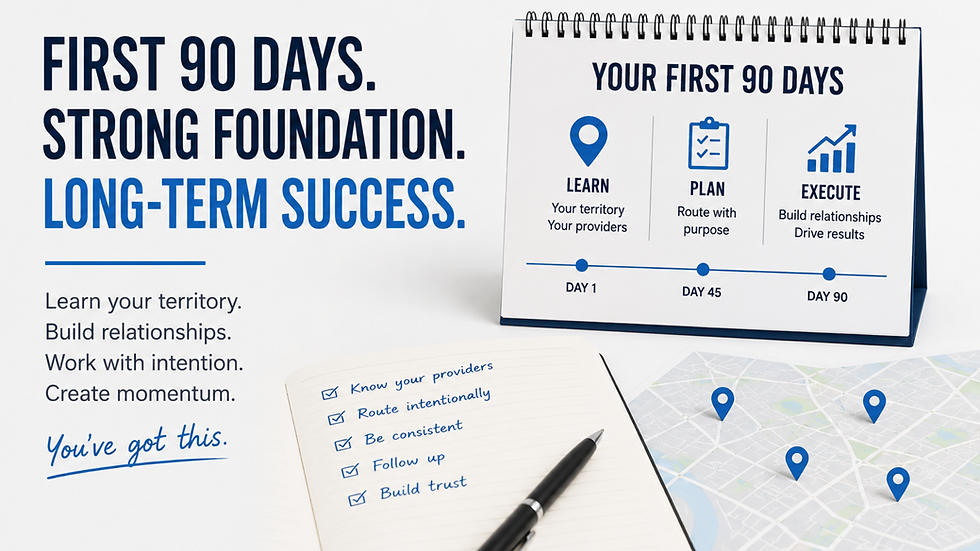
The first 90 days in medical sales can feel overwhelming.
Whether you’re:
Breaking into medical sales for the first time
Taking over a new territory
Starting with a new company
You’re stepping into an environment with a steep learning curve and high expectations.
New products.New providers.New geography.New systems.New pressure.
One of the biggest mistakes reps make early on is assuming success comes from trying to do everything at once.
It doesn’t.
A strong pharma sales strategy during your first 90 days is less about perfection and more about building structure, learning your territory, and creating consistent habits that compound over time.
The Real Goal of the First 90 Days
Many new reps focus too heavily on immediate results.
They want:
Fast wins
Quick relationships
Immediate traction
But the first 90 days are really about building a foundation.
An effective pharma sales strategy starts with:
Learning your territory
Understanding your providers
Building consistency
Creating a repeatable system
The reps who do this well position themselves for long-term success.
The reps who skip this phase often spend months reacting instead of executing strategically.
1. Learn Your Territory Before Trying to “Master” It
One of the biggest mistakes new reps make is trying to move too fast before understanding the territory.
In the beginning, focus on learning:
Where providers are located
Which areas are dense with targets
Which offices are difficult to access
How geography impacts your day
This matters more than most people realize.
A successful pharma sales strategy isn’t just about selling.
It’s about managing movement efficiently.
If you don’t understand your territory geographically, your days quickly become reactive.
You’ll:
Waste time driving inefficiently
Bounce between disconnected offices
Miss opportunities to build consistency
The faster you learn your territory layout, the faster you gain confidence.
2. Prioritize Routing Early
Most new reps underestimate how important routing is.
They think: “I’ll figure that out later.”
But routing affects almost everything:
Time management
Territory coverage
Number of quality calls
Energy levels
Consistency
The reps who learn to route effectively early usually ramp faster because they:
Spend less time planning
Reduce wasted drive time
See more priority providers consistently
Good routing creates structure.
And structure is critical during your first 90 days.
This is where tools like AtlasRx can help. By giving reps structured routing guidance, AtlasRx helps reduce the time spent figuring out where to go and allows more focus on learning the territory and building relationships.
Why Routing Feels So Difficult at First
In the beginning, routing is mentally exhausting.
You’re trying to manage:
Provider locations
Office hours
Access challenges
Appointment schedules
Geography
Priority accounts
At the same time, you’re still learning:
Your product
Your messaging
Your territory strategy
That’s a huge mental load.
And many new reps spend more mental energy figuring out where to go than preparing for the actual conversation.
3. Focus on Consistency Over Perfection
One of the biggest traps in a new role is trying to build the “perfect” plan.
The reality is:
Your first routes won’t be perfect
Your territory understanding won’t be perfect
Your conversations won’t be perfect
That’s normal.
What matters is consistency.
Consistent:
Territory coverage
Follow-up
Learning
Daily structure
Small improvements every week matter far more than trying to optimize everything immediately.
4. Learn Provider Access Patterns Quickly
Not every provider operates the same way.
Some offices:
Are easy to access
Welcome reps regularly
Allow flexibility
Others:
Are highly restricted
Require appointments
Have limited availability windows
One of the fastest ways to improve efficiency is learning:
Which providers are realistically accessible
When they’re accessible
Which offices are worth prioritizing
This type of field intelligence becomes incredibly valuable over time and is a major part of a strong pharma sales strategy.
5. Build Relationships With Staff Early
New reps often focus entirely on providers.
But office staff can dramatically impact:
Access
Scheduling
Timing
Overall experience
Learning names.Being respectful.Showing consistency.
Those small actions matter — especially early.
Strong staff relationships often create smoother routing and better long-term access.
6. Don’t Just Chase Activity
In the beginning, it’s easy to think:“I just need to stay busy.”
And yes, activity matters.
But there’s a difference between being active and making progress
You can:
Drive all day
Make a high number of calls
Stay constantly busy
And still not build momentum.
A better pharma sales strategy focuses on intentional activity.
Every call should have a purpose:
Build familiarity
Learn something new
Advance the relationship
Improve understanding of the account
That’s how progress compounds over time.
7. Develop a Weekly Planning Routine
One of the best habits you can build early is a weekly planning routine.
Every week:
Review your targets
Look at upcoming priorities
Build geographic clusters
Plan around appointments and access
This prevents the constant:“Where should I go next?” mindset.
And that matters more than most people realize.
Because mental fatigue builds quickly in medical sales.
The more decisions you make throughout the day:
The more reactive you become
The less focused your conversations become
Planning ahead protects your energy.
AtlasRx simplifies weekly territory planning so reps can stay focused on execution rather than rebuilding their route each week.
8. Use Drive Time Strategically
New reps often waste drive time unintentionally.
Instead, use that time to:
Prepare for upcoming calls
Reflect on previous conversations
Think through objections
Review provider insights
The best reps turn windshield time into preparation time.
That shift alone can improve call quality dramatically.
9. Be Organized With Notes and Follow-Ups
Your first 90 days involve information overload.
If you don’t organize what you’re learning, valuable insights disappear quickly.
Track:
Provider preferences
Office dynamics
Access notes
Follow-up opportunities
Conversation details
Over time, this becomes one of your biggest competitive advantages.
10. Understand That Territory Management Is a Skill
Many people think medical sales success is mostly about personality or communication.
Those matter.
But territory management is a massive part of long-term performance.
The reps who consistently hit quota usually:
Work their territory intentionally
Route efficiently
Prioritize effectively
Stay organized
That’s not luck.
That’s structure.
And structure is a key component of an effective pharma sales strategy.
How AtlasRx Helps New Reps Ramp Faster
This is exactly where tools like AtlasRx can make a difference.
One of the hardest parts of a new role is the mental burden of:
Learning geography
Building routes
Prioritizing providers
Managing territory coverage
AtlasRx helps reduce that burden by creating structured routing built around:
Provider priority
Geography
Frequency goals
Territory organization
Instead of spending hours manually rebuilding routes, reps can spend more time:
Learning the territory
Preparing for conversations
Building relationships
That’s especially valuable in the first 90 days, when mental bandwidth is already stretched thin.
Why Reducing Mental Load Matters
In a new role, cognitive overload is real.
You’re trying to absorb:
Product knowledge
Territory dynamics
CRM systems
Competitive messaging
Provider relationships
Adding constant routing decisions on top of that becomes exhausting.
The less mental energy spent on logistics:
The more energy available for execution
The more focused conversations become
The faster confidence builds
That’s one of the hidden advantages of structured routing.
The Compounding Effect of Good Habits
The first 90 days are less about immediate perfection and more about building systems.
Because the habits you create early tend to compound:
Strong territory organization
Consistent routing
Better follow-up
Intentional planning
Those things create momentum.
And momentum creates confidence.
Summary
Success in your first 90 days as a medical sales representative rarely comes from trying to do everything perfectly.
It comes from:
Building structure
Learning your territory
Managing your time intentionally
Staying consistent
Medical sales is demanding.
There’s a constant mental load that comes with balancing providers, geography, access, and expectations.
That’s why routing matters so much.
Because the better you understand and organize your territory, the more effective you become in the field.
And when tools like AtlasRx help reduce the manual burden of territory planning, reps gain something incredibly valuable:
More time
More focus
More bandwidth to do what actually drives success — building meaningful relationships and executing consistently in the field
A strong pharma sales strategy isn’t about trying to do everything.
It’s about creating structure that allows you to execute consistently over time.


Comments